

"You are too small for hackers to bother with." Maybe you heard it from a friend at the Chamber mixer, a vendor, or your own gut. The big breaches are the ones on the news, so a shop with a few employees and one office computer feels invisible.
Here is the cost of believing it, in one sentence: if you think nobody would bother with you, you probably have not turned on the one setting that stops most break-ins.
I am Robert, and I help Tyler homes and small businesses with their tech. This is one of the most common things I hear from owners, so let me walk through why it sounds right, what the numbers say, and three free things you can do today.
📣 What You'll Hear
The advice is that hackers go after banks, hospitals and big companies, so a small business has nothing worth taking and nothing to worry about.
It usually sounds like this: "Who would want my files?" "We only have ten customers." "We do not have anything they want." People who say it are not being careless. They are being reasonable, based on what they see in the news.
🤔 Why It Sounds Right
It sounds right because the breaches you hear about really are the big ones. Nobody writes a headline about a four-person plumbing company losing its customer list, so it feels like it never happens.
The first half is true. A small shop does not have a famous name or millions of customer records. The mistake is thinking criminals pick targets by fame. Most of them pick targets by how easy the door is to open.
🔎 What Actually Happens
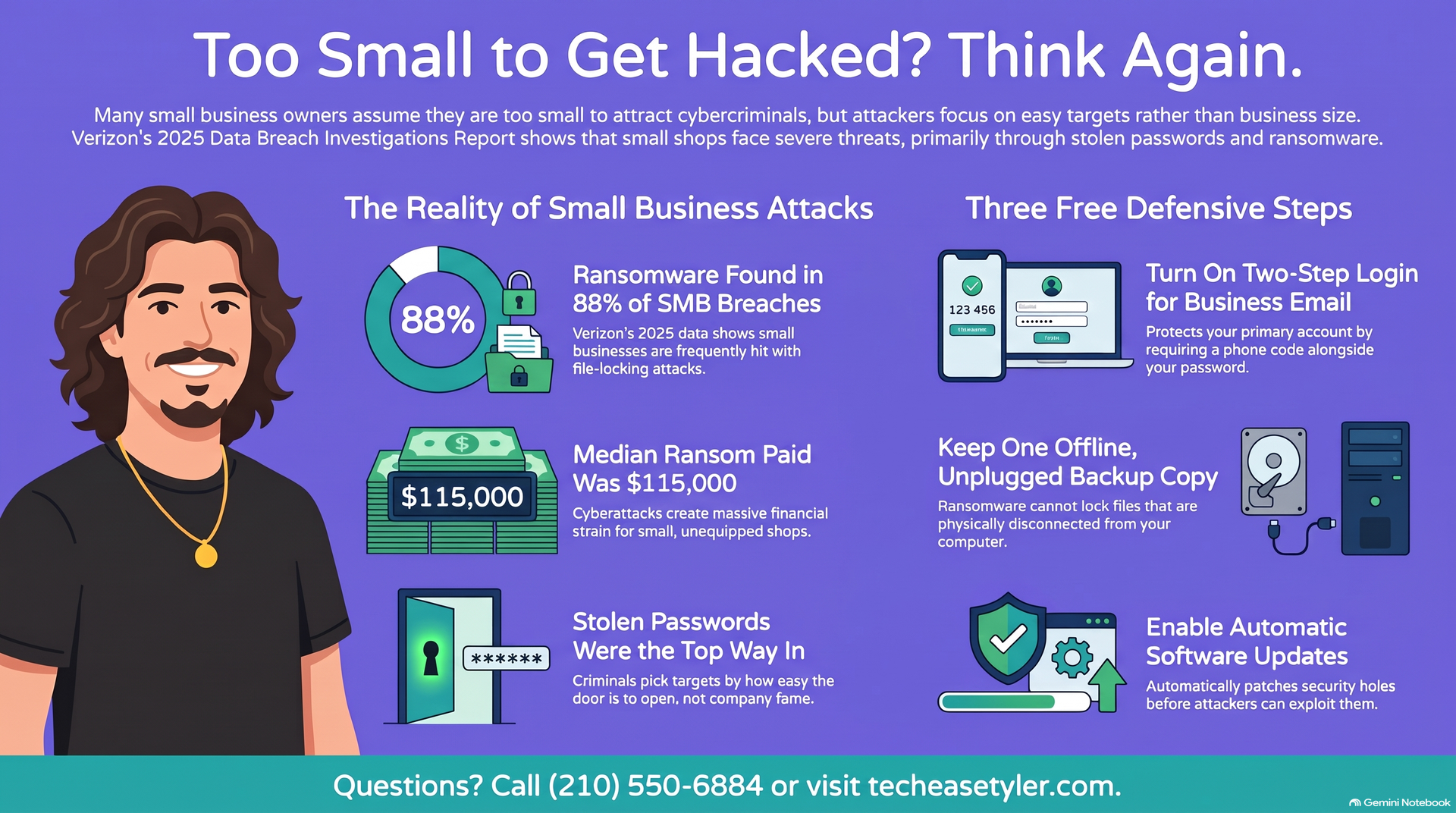
Small businesses get hit, and often with the worst kind of attack. In Verizon's 2025 Data Breach Investigations Report small business snapshot, ransomware (a program that locks your files until you pay) showed up in 88% of the breaches at small and mid-size businesses. For large companies the number was 39%.
Verizon's own researchers say the data refutes the idea that ransomware groups only go after big companies. Their words: ransomware groups "don't seem to care what size an organization is." The same report adds that small businesses are less likely to have up-to-date, readily available backups than a large company, which makes them easier to squeeze.
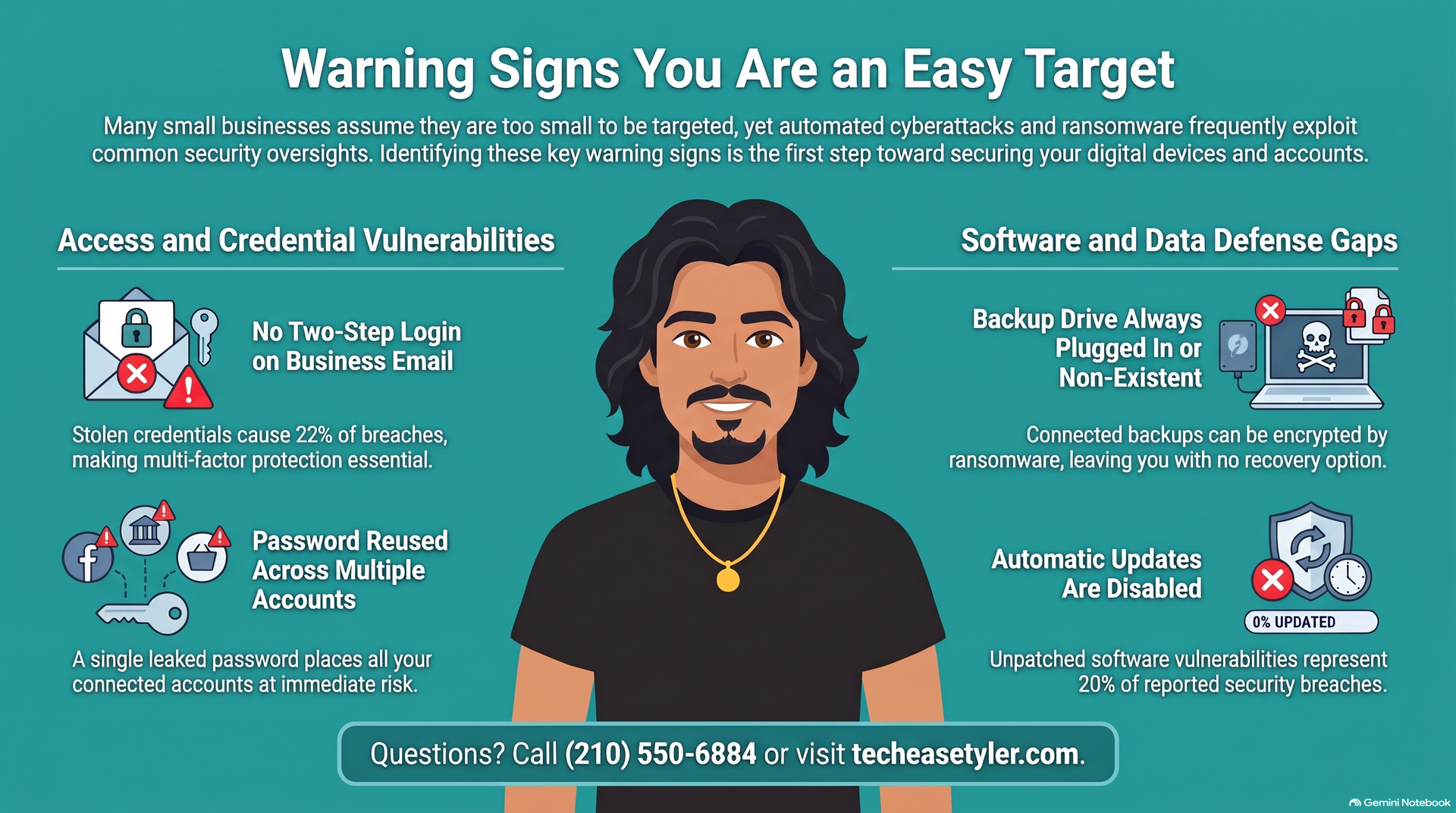
How do attackers get in? In the full Verizon 2025 report, stolen or guessed passwords, which Verizon calls credential abuse, were the most common way in at 22% of breaches. Taking advantage of known flaws in software that was never updated was next at 20%.
Two fair notes. Verizon counts any business under 1,000 employees as small, so a Tyler shop with three people is much smaller than that. And the report only covers breaches that were investigated and reported to Verizon, not every business out there. Still, Verizon points out that these attackers' methods are similar no matter the size of the victim. That is why the basics below matter just as much for you.
This is the same pattern as other confident tips that fall apart when you check, like the one about paying for virus protection you do not need. I covered that in Why I Don't Use Paid Virus Protection. Good protection is usually simpler and cheaper than the sales pitch.
✅ Do This Instead
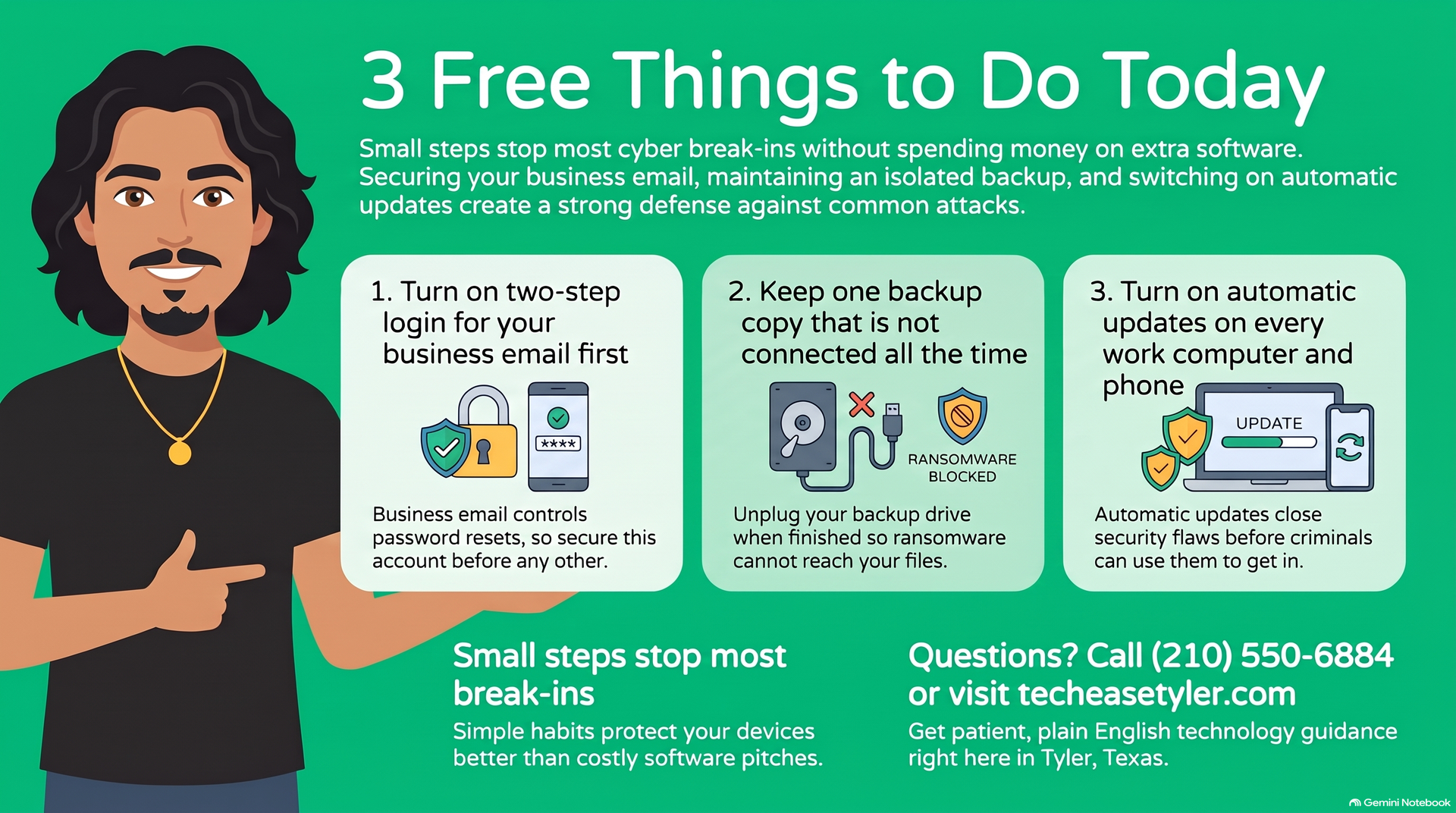
Three free steps cover most of what keeps a small business out of trouble, and you can do all three today.
Email is the key to everything else, because "forgot my password" links go there. Open your email account's security settings and turn on two-step login (also called two-factor), where a code from your phone is needed on top of your password. CISA walks you through it. Do email first, then your bank and accounting accounts.
Copy your important files, like customer lists and invoices, to an external drive or a cloud backup, then unplug the drive when the copy finishes. Ransomware cannot lock what it cannot reach. The FTC also recommends regular backups, kept off your main network.
Updates close the holes criminals use. Look in Settings for "automatic updates" and switch it on, as CISA explains. If you are still on an older Windows 10 machine, see how to keep your computer safe.
None of these cost money, and none need a tech person.
Start with step 1 tonight. If you only do one thing from this post, make it that one.
❓ Quick Answers
Are small businesses really targeted by hackers?
Yes. Verizon's 2025 report recorded 3,049 incidents at small businesses (under 1,000 employees) compared with 982 at large ones, and that is only the cases that came to its attention. Verizon says part of that gap is simply that there are more small businesses than big ones.
What is the first thing a small business should do for security?
Turn on two-step login for your business email. Stolen passwords were the most common way in at 22% of breaches in Verizon's report, and a second step makes a stolen password far less useful to a thief.
What is ransomware in plain English?
It is a program that locks your files and demands money to unlock them. A backup copy that is kept disconnected from your computer is your best way out, because you can restore your files without paying anyone.
What if someone calls and offers to fix my security for a fee right now?
Slow down. Pressure and big promises are how scams work, which I explain in The Fake Deputy Bitcoin Trap. Take a day, ask for it in writing, and call someone you trust.
God Bless.
Robert
Owner, TechEase
"No jargon, no judgment, just patient help that makes sense."
📞 (210) 550-6884 | Transparent Flat-Rate Pricing | We Come to You