
I wish I didn’t have to write a follow-up to last months’s scam alert, but here we are. A “Fake Deputy” Bitcoin scam that has been targeting families of inmates in Smith County is going strong, and local authorities say more victims are coming forward every day. No worries. Everything you need is right here.
This scam has now been officially documented by the Smith County Sheriff’s Office, reported by the Tyler Morning Telegraph, and covered on KETK News. Real people in our community, our neighbors, are losing thousands of dollars. One resident lost $5,500 at a gas station Bitcoin ATM on Highway 64 West. Another lost $1,800 a few weeks before that. The money is gone the moment they scan that QR code.
Let’s break down exactly how this works, who it targets, and, most importantly, how to make sure it never happens to you or anyone you love.
📺 Watch: TechEase TechTalks — Scam Breakdown
Before we go further, here’s a short video overview of exactly how this scam works and what to watch for:
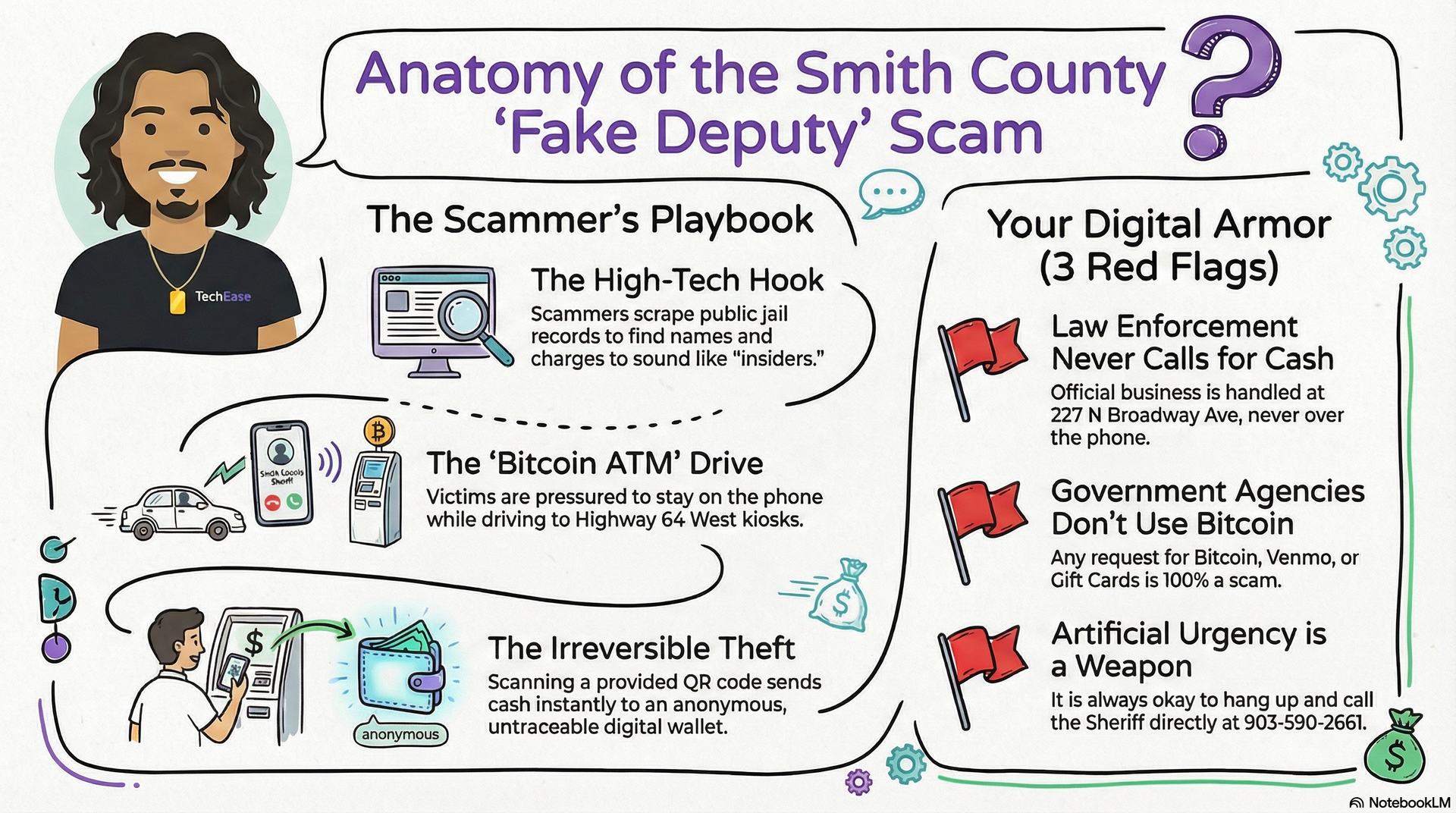
🔍 How the Scam Works, Step by Step
Scammers running this operation are organized and patient. They don’t call randomly. They do their homework first. Here’s the full playbook they’re using on our neighbors right now.
Scammers run automated software that scrapes Smith County’s public jail records around the clock. The moment someone is booked, they have the name, charges, and booking time, all legally public under Texas law.
Using the same people-search databases anyone can buy access to, they trace the inmate back to their family, finding your phone number, your name, even your address.
You get a call from “a Sheriff’s Lieutenant” or “Smith County Pretrial Services.” Your caller ID might even show a local number. They recite your relative’s name, charges, and booking date. It feels eerily real.
They tell you your loved one qualifies for release, but only if you pay an “ankle monitor activation fee” or “bond processing fee” right now. The window closes soon. They keep you panicked and on the line.
They tell you to stay on the phone and drive to a gas station or convenience store, often on Highway 64 West, that has a Bitcoin ATM. The goal is to isolate you from anyone who might talk you out of it.
They text you a QR code. You feed cash into the machine, scan the code, and your money is instantly sent to a private wallet anywhere in the world. It’s gone in minutes, and it cannot be reversed. Ever.
🤔 Why Does It Feel So Real? (And Why That’s the Point)
I hear this every single time: “Robert, how did they know my grandson was actually in jail?”
Here’s the answer, and I want you to really understand this: the information they have is not secret. Under the Texas Public Information Act, arrest records, names, charges, booking times, are public documents. Anyone can access them. Scammers just built software to read that list automatically, 24 hours a day, the second it updates.
When a caller rattles off accurate details about your family member, it feels like they must be calling from inside the system. That’s exactly the reaction they’re engineering. The knowledge doesn’t prove they’re legitimate; it proves they’re sophisticated criminals. (If only they would apply half this effort to something productive!)
🛡️ The 3 Red Flags — Your Digital Armor
If you only remember three things from this post, make it these. I call them your “Digital Armor” because they work 100% of the time against this scam.
The Smith County Sheriff’s Office will NEVER call you to demand money over the phone, not for bond, not for warrants, not for fees of any kind. Real payments happen at the courthouse window at 227 N Broadway Ave or through official county websites. The second someone asks for money on the phone, the call is a scam. Period.
No government agency, not the Smith County Sheriff, not the IRS, not Social Security, will ever ask you to pay using Bitcoin, Venmo, Cash App, or retail gift cards. These are untraceable, irreversible methods that scammers use specifically because the money vanishes immediately. Legitimate fines go through official payment portals, money orders, or cashier’s checks directly to the county.
Scammers keep you on the phone because the moment you hang up and call your spouse, your daughter, or the actual Sheriff’s Office, the spell is broken. They know that. Real legal matters give you time to verify. It is always okay, and always the right move, to hang up and call the official number independently. Disconnecting is not illegal. It’s just smart.
₿ Why Bitcoin Makes This Almost Impossible to Undo
A lot of people ask me: “Can’t the police just get the money back?” I wish the answer were yes. Here’s the honest truth about why it’s so difficult, explained without all the tech jargon.
When you use a regular bank or credit card, there’s a central company in the middle, Visa, Bank of America, whoever, that keeps records and can reverse a transaction if fraud is reported quickly enough. Bitcoin has no company in the middle. It runs on a decentralized global network where every transaction is permanent the moment it’s confirmed, usually within minutes.
On top of that, as soon as your money hits their wallet, as KETK News reported, the funds are rapidly moved through a complex web of multiple private wallets, making it nearly impossible for even federal cybercrime units to trace. The trail goes cold almost immediately.
📍 Real Incidents Right Here in Tyler
These aren’t stories from somewhere else. According to reporting by the Tyler Morning Telegraph, here’s what has already happened in our community:
A local woman received a call from someone impersonating a Sheriff’s Lieutenant who told her that her son needed an ankle monitor to be released. She drove to a Bitcoin ATM and sent $1,800 via QR code before realizing she’d been scammed.
A resident was told her brother could be released if she paid a processing fee. She was directed to a Bitcoin ATM at a gas station on Highway 64 West and deposited $5,500. The money is gone.
These are real families. Real savings. Gone in the time it takes to make a drive across town.
⚖️ What Real Bond and Pretrial Release Actually Look Like
One of the best defenses against this scam is simply knowing how the real process works. When someone is arrested in Smith County, here’s what genuinely happens:
After booking, a magistrate reviews the case and officially sets bail, usually within 48 hours. If a family wants to pursue release through the Smith County Pretrial Release Office (established 1979), the defendant submits a formal written application. A bond investigator conducts an interview and background check. The case is then reviewed by a judge, who must personally sign off on the release before anything happens.
The official bond fee is exactly $20 or 3% of the bond amount, whichever is greater. That fee is paid in person at the Pretrial Bond Office, in cash, money order, or cashier’s check. A physical receipt is issued. The jail is then formally contacted to authorize release.
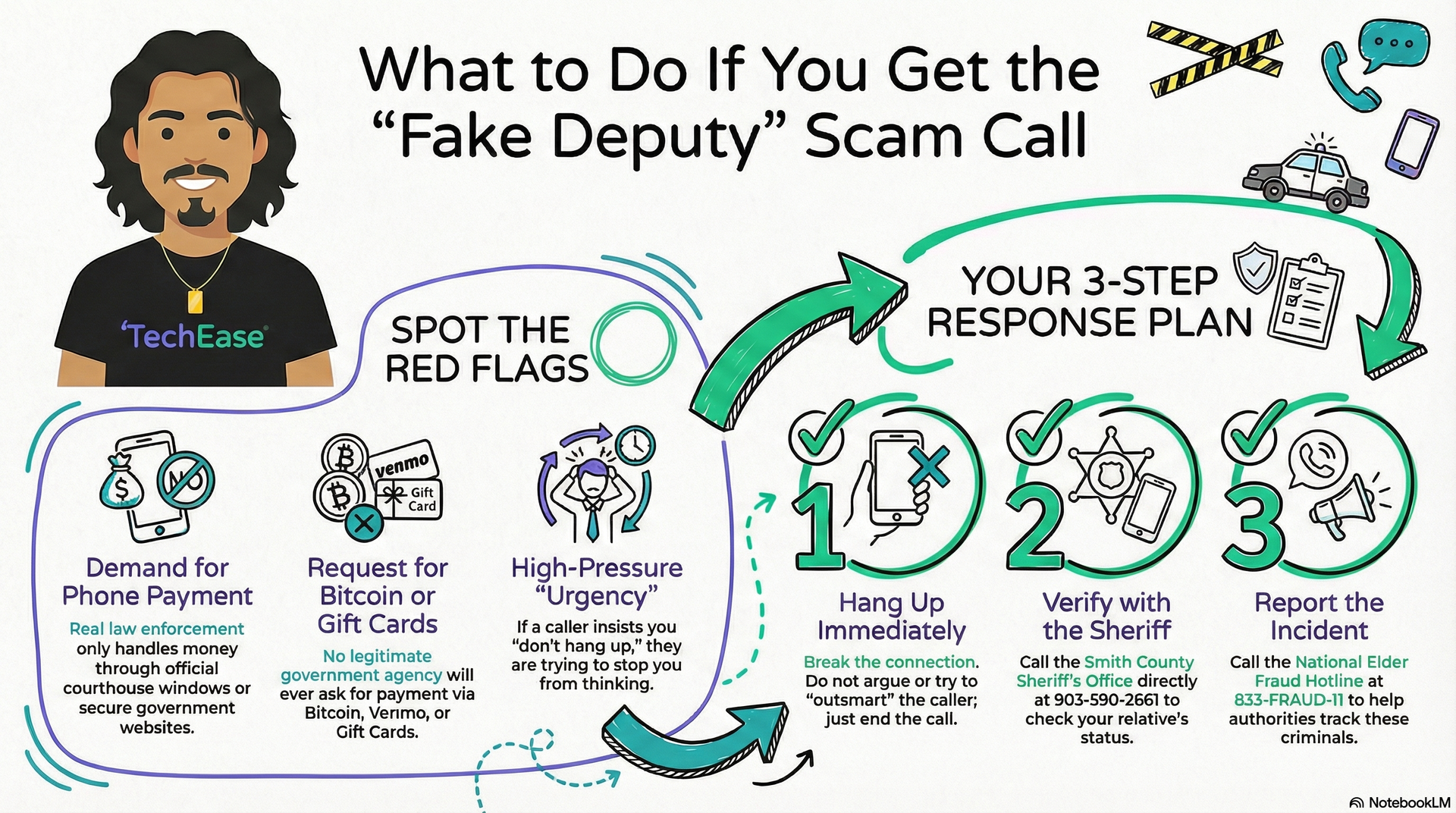
✅ What To Do Right Now If You Get This Call
Don’t try to argue or “catch” them. Don’t feel rude about it. Just hang up. Breaking that connection is the single most effective thing you can do.
Scammers spoof caller IDs. Calling the number back just reconnects you to them. Find the real number independently. Do not use anything they gave you.
Call 903-590-2661 to verify your relative’s status directly. You can also call the Main Jail at 903-590-2800, or Pretrial Release at 903-590-2620.
Tell a family member, a neighbor, anyone. Share this post. The more people in Tyler who know about this scam, the fewer victims there will be.
Even if you didn’t lose money, report the attempt. Every report helps authorities track the pattern. Call the non-emergency line or use smith-county.com.
Contact your bank’s fraud department immediately. Then call the Sheriff’s White Collar Crime Division at 903-590-2661 and file a federal report at ic3.gov.
📞 Verified Contact Numbers — Save These Now
Copy these into your phone contacts tonight. Don’t wait until you’re in a panic to try to find them.
🔑 One Extra Layer of Protection: The Family Code Word
This is something I recommend to every family I work with, and it takes about 30 seconds to set up. Before you get off the phone tonight, agree on a secret word with your close family members, something simple that only you all would know, like a pet’s name or a memorable vacation spot.
Here’s how it works: if you ever get a call claiming your relative is in trouble, or if a caller says they are your relative (scammers sometimes use voice-altering tech), just ask for the code word. A real family member will know it. A scammer won’t. That’s the end of the call.
Stay safe, Tyler.
Robert
Owner, TechEase
“No jargon, no judgment, just patient help that makes sense.”
📞 (210) 550-6884 | Transparent Flat-Rate Pricing | We Come to You