
In July, Tyler said no. Now the developer is back, and the fight moves to a different board. Here is everything you need to know before Wednesday's vote, with sources, so you can decide for yourself.
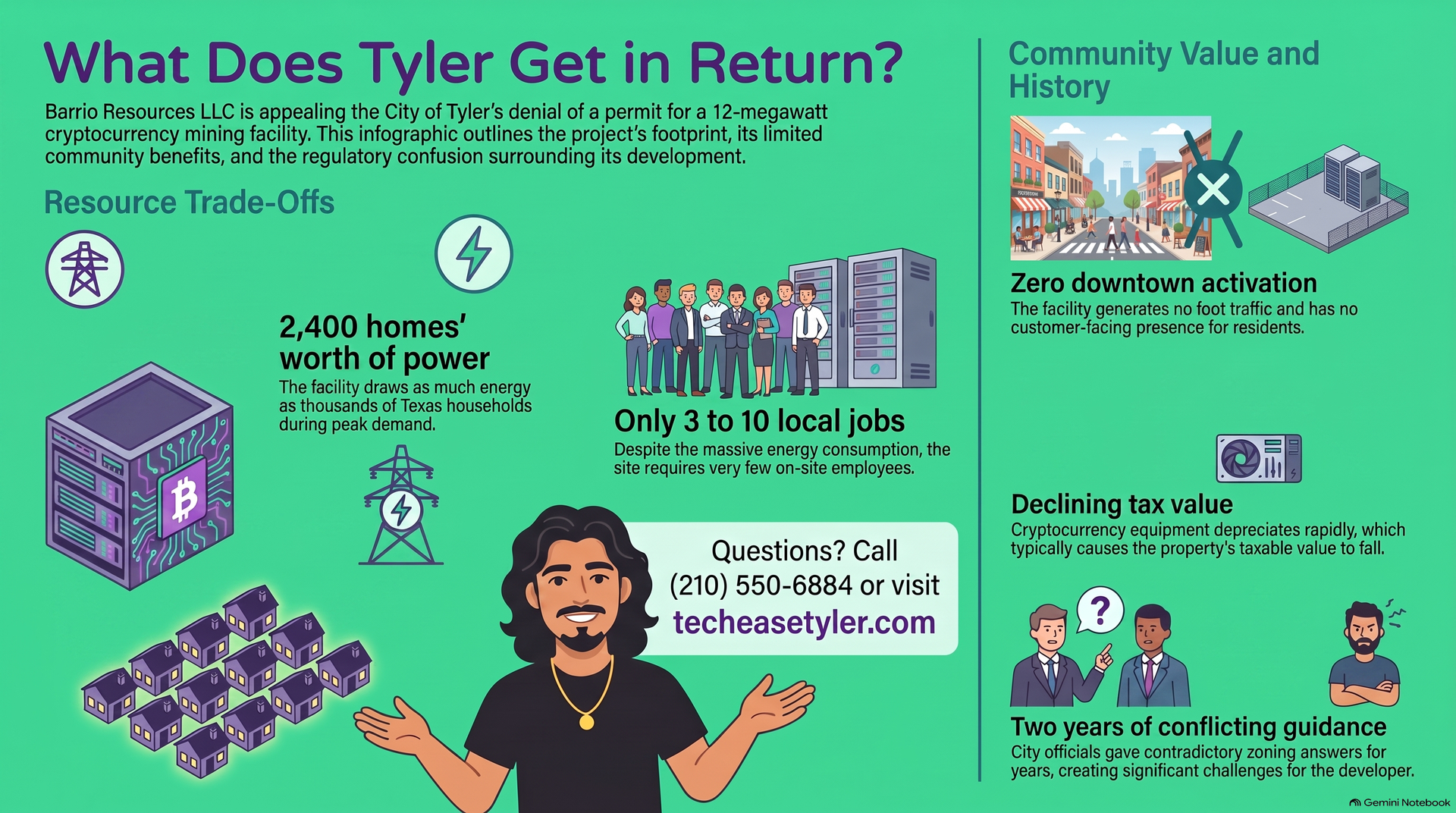
Barrio Resources LLC has appealed the City of Tyler's denial of a Special Use Permit for a 12-megawatt cryptocurrency and high-performance computing mining facility at 1101-1105 West Erwin Street in downtown Tyler. The Zoning Board of Adjustment (ZBA) meets this Wednesday, September 3, to decide whether it even has the authority to hear that appeal.
@robertfromtechease Tyler Texas, we have 3 days. 🛑 A massive Bitcoin data center is up for a vote on Sept 3. I read the reports so you don't have to. Watch to see how this impacts our grid and our homes. Share this until it hits the phone screens of the people voting on this! Full breakdown at techeasetyler.com. (sorry if its not up yet im going as fast as I can!) Let's look out for each other. Lets stop this thing! #TylerTX #EastTexas #TechEaseTyler #datacenter #datacenters
♬ original sound - Robert From TechEase
🔍 What Happened (Timeline)
Senior Planner Tharani Devi Palma emails that a "Data Processing Center" is allowed by right in the M-1 (Light Industrial) zone. No permit needed.
Barrio Resources LLC purchases the property, investing approximately $200,000 in rehabilitation and paying $154,310.40 to Oncor for electrical infrastructure.
Planning Director Kyle Kingma emails that crypto mining is an "unlisted use" that requires a Special Use Permit.
Planning Technician Marina Lopez emails that a Special Use Permit is NOT required, contradicting Kingma.
Barrio Resources LLC submits Special Use Permit applications.
The Planning and Zoning Commission denies the permit 5 to 2. Twenty-six residents spoke against the project and five spoke in favor.
Barrio Resources LLC files two appeals.
The ZBA holds a hearing on jurisdiction, but takes no action.
The ZBA votes on whether it has jurisdiction to hear the appeal at all.
If jurisdiction is affirmed, the ZBA hears the merits of the appeal.
Timeline dates, staff names, and dollar figures are drawn from the City of Tyler meeting packet and correspondence on file for this case.
🔊 The Noise Problem Nobody Is Talking About
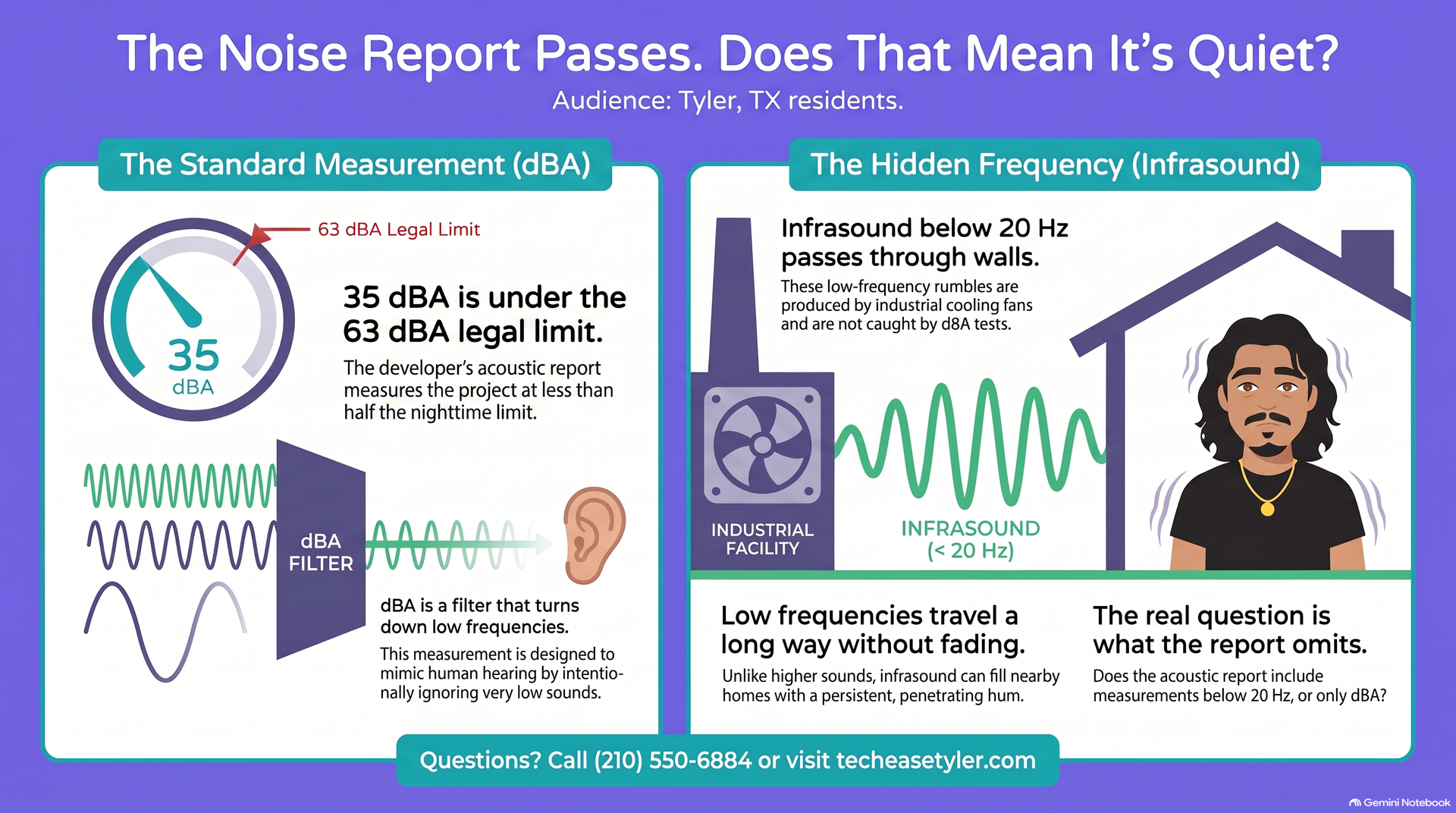
The developer's acoustic assessment, prepared by Hoover & Keith, Inc., concludes worst-case noise at the nearest home would be about 35 dBA, well under the City's 63 dBA nighttime limit. On paper, that passes.
Here is the catch. That number is measured in dBA, in A-weighted decibels. A-weighting is a filter built to match what the average human ear hears best, and by design it turns down very low frequencies. The lower the pitch, the more an A-weighted meter discounts it (how A-weighting works, engineering reference). So a reading in dBA can look quiet while missing the exact kind of sound these facilities are known for.
That sound is infrasound, low-frequency rumble, generally below 20 Hz, produced by banks of high-velocity industrial cooling fans running 24/7. Infrasound behaves differently from ordinary noise. The waves are long, they pass through walls and windows, and they travel a long way without fading. Because standard dBA and dBC noise rules were not built to catch it, a facility can be "within the limit" and still fill nearby homes with a persistent hum or pressure.
Musician and acoustic-science investigator Benn Jordan has documented this at data centers in the field and calls the worst of it an "acoustic weapon." You can watch his breakdowns here:
Datacenters Behaving Like Acoustic Weapons
Infrasound: What You Can't Hear CAN Hurt You
In fairness, the health effects of sub-audible infrasound are an active scientific debate, and some acousticians argue the risk at these levels is overstated. That is exactly why the measurement method matters. Reasonable people can disagree about health thresholds, but the underlying engineering fact is not in dispute. An A-weighted reading is not designed to capture low-frequency energy.
We do not have to guess about what happens near one of these mines. In Granbury, Texas, residents living near a Marathon Digital (MARA) Bitcoin facility have reported serious problems. TIME interviewed more than 40 residents describing migraines, vertigo, hearing loss, high blood pressure, and sleep loss they attribute to the mine (TIME, "Inside the 'Nightmare' Health Crisis of a Texas Bitcoin Town"). The local constable recorded noise "capping out at 91 decibels" and issued citations more than 35 times in 2024.
It is worth being precise about how the court case ended, because it is often described incorrectly. In July 2024, a Hood County jury acquitted the site manager, David Fischer, of all 12 noise-violation charges. Jurors reportedly agreed the noise was unreasonable but had trouble tying it to Fischer personally, and the defense argued the sound measurements were flawed (Decrypt, "Texas Jury Sides With Bitcoin Miner Marathon"). The nuisance did not go away with that verdict. In October 2024, the environmental law group Earthjustice filed a private nuisance lawsuit on behalf of Citizens Concerned About Wolf Hollow, representing residents reporting permanent hearing loss, severe migraines, tinnitus, and debilitating vertigo, and asking a court to order the noise stopped (Earthjustice press release).
This kind of noise does not only affect people. Constant low-frequency sound can mask wildlife communication, raise stress in animals, and push them out of their habitat.
⚡ What 12 Megawatts Really Means
According to the Electric Reliability Council of Texas (ERCOT), one megawatt (MW) powers roughly 200 Texas homes during periods of peak demand (ERCOT figure, via CBS Austin).
That puts 12 MW at roughly 2,400 homes' worth of electricity at peak, for a facility that would employ 3 to 10 people, according to Barrio Resources LLC's own documents. (Estimates that use year-round average household use run higher, but at the moment the grid is most stressed, ERCOT's own rule of thumb is about 200 homes per MW.)
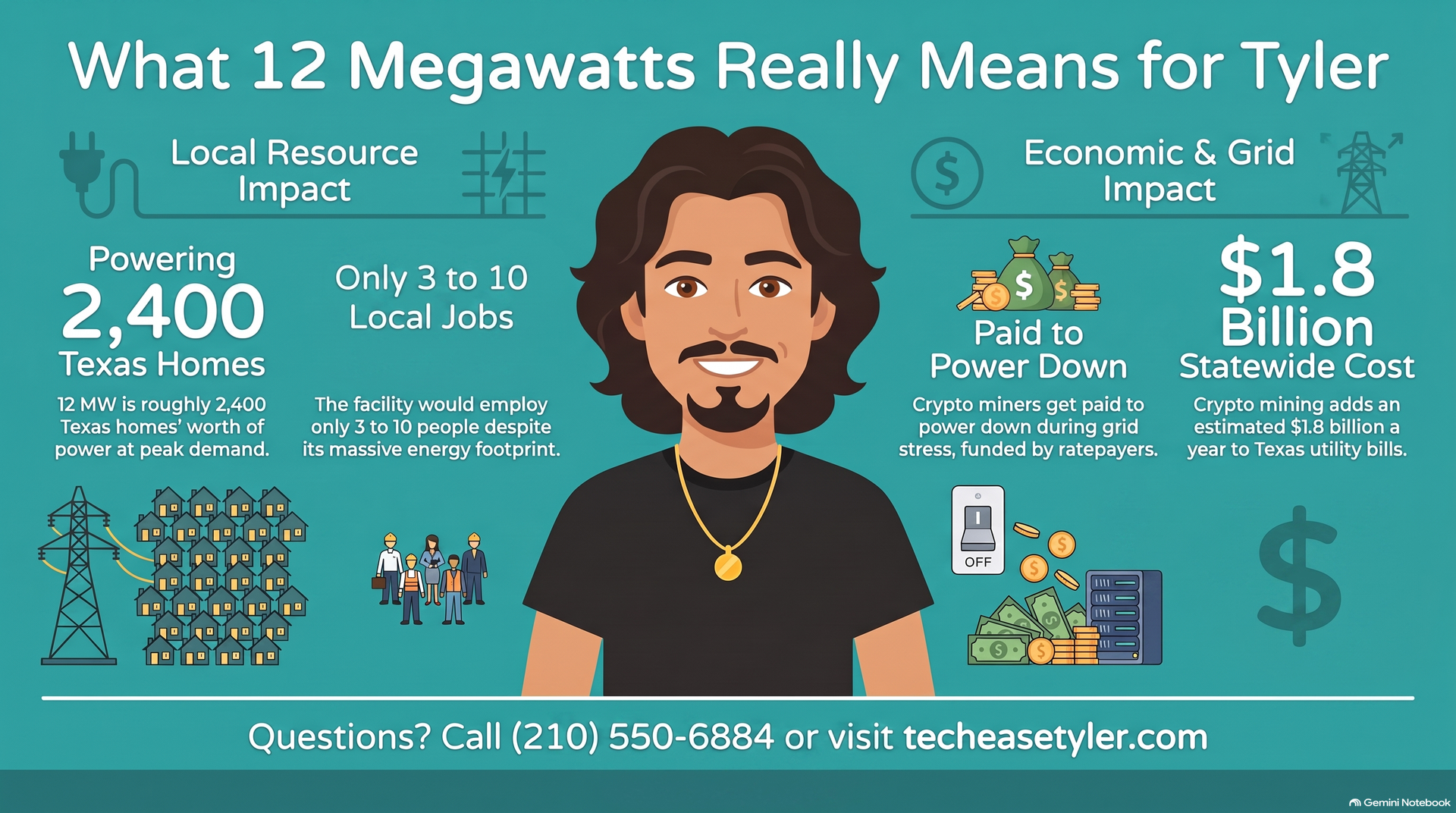
Then there is the business model. Crypto mines participate in ERCOT "demand response" programs as large flexible loads. They get paid to power down when the grid is stressed. In August 2023, Riot Platforms received about $31.7 million in power and demand-response credits ($24.2 million in power credits plus $7.4 million in demand-response credits). Riot's own release notes those credits were worth roughly 1,136 Bitcoin that month, while the company actually mined 333 Bitcoin. Riot earned far more from powering down that month than from mining. (Riot Platforms, August 2023 update; CNBC). Those credits are ultimately funded through the rates everyone else pays.
Zoom out to the whole state. An analysis by the energy consulting firm Wood Mackenzie found that crypto mining has already raised Texas residents' electricity costs by about $1.8 billion per year, roughly 4.7% of their bills (Grist; The Cool Down). The crypto industry disputes that figure, arguing it relies on proprietary modeling rather than public real-world data, a fair point to keep in mind.
For context on scale and oversight, Texas Senate Bill 1929 (2023) requires crypto-mining operations with a load of more than 75 megawatts to register with the Public Utility Commission and ERCOT and disclose their power use (Texas SB 1929 bill analysis). At 12 MW, this Tyler facility sits well below that state registration threshold, so most of the disclosure would happen, or not, at the local level.
Here in East Texas, where Oncor outages and weather-related grid stress are already a regular worry, adding a facility that draws thousands of homes' worth of power is a real consideration.
⚖️ The Community Value Question
Put together, the proposal is a facility that draws roughly 2,400 homes' worth of power, creates 3 to 10 jobs, and has a business model that includes being paid not to run when the community needs power most. It brings no foot traffic, no customer-facing presence, and no downtown activation. And because mining hardware depreciates fast, the taxable value tends to fall over time rather than grow.
We do not tell you what to think. We ask: what does Tyler get in return?
✅ What You Can Do
September 3: the ZBA holds its jurisdiction vote. September 10: a potential merits hearing, if jurisdiction is confirmed.
Share this post so your neighbors understand the situation before the vote.
Reach the Mayor and City Council with your thoughts through their official contact page.
Attend the meetings if you can, and hear the facts for yourself.
We have covered this facility from the start. If you want the fuller background, see our earlier posts What a Bitcoin Mining Facility Would Really Mean for Tyler and Tyler Said No to the Bitcoin Mine: Here's the Math That Proves We Were Right.
God Bless.
Robert
Owner, TechEase
"No jargon, no judgment, just patient help that makes sense."
📞 (210) 550-6884) | Transparent Flat-Rate Pricing | We Come to You