

The phone rings. It sounds exactly like your grandson's voice, shaking and scared. He says he is in jail and needs $3,000 in gift cards to get out. But it is not your grandson. It is a criminal using artificial intelligence, and this is happening to families in Tyler right now.
Scams have always been around, but in the last year or two they have gotten smarter, faster, and a lot more convincing. Today I want to walk you through five of the newest ones I am seeing reported, including three that are spreading quickly across East Texas. For each one I will tell you exactly what to look for and what to do.
None of this is your fault. These are highly sophisticated criminal operations. The best protection is simply knowing they exist.
🔍 Scam #1: The AI Voice Cloning Call
This one is brand new and it is genuinely scary. Criminals can now use artificial intelligence to copy someone's voice from just a few seconds of audio, like a video posted on Facebook or a short voicemail. They use that cloned voice to call you pretending to be your child, grandchild, or close friend.
The caller sounds completely real. They say they are in trouble, maybe a car accident, maybe arrested, maybe sick in a hospital. Then a second person gets on the line, usually someone pretending to be a lawyer, police officer, or hospital worker. They tell you not to say anything to anyone while this process is underway, and they need money fast, usually through gift cards or a wire transfer.
According to the Federal Trade Commission, AI-assisted fraud like this has caused millions of dollars in losses and is growing rapidly. The AARP Fraud Watch Network has flagged it as one of the top emerging threats for older Americans.
Real emergencies handled by real organizations never require gift cards. If anyone asks you to buy Apple, Google Play, or Walmart gift cards to help someone, hang up immediately. That is always a scam.
Scammers always try to isolate you from family. A real police officer, lawyer, or hospital worker will never tell you to keep this secret from your spouse or children.
If something feels off, trust that feeling. Hang up and call your loved one directly on their regular number. Every single time. Even if the voice sounded perfect.
🔍 Scam #2: QR Code Phishing (They Call It Quishing)
You have probably seen QR codes, those little square barcodes you point your phone camera at. Restaurants use them for menus. Businesses use them to direct you to websites. They are everywhere now, and criminals are taking advantage of that.
In this scam, a fake QR code is placed somewhere you trust. It might be a sticker placed over a real QR code at a parking lot payment machine. It might be in an email pretending to be from your bank. When you scan it, instead of going to a real website, it takes you to a fake one that looks exactly like your bank, Medicare, or Amazon login page. You type in your username and password, and now the scammer has it.
The FBI issued a public warning about malicious QR codes, noting that criminals are specifically placing fake codes over payment kiosks in parking garages and city lots.
Your bank, Social Security office, or Medicare will never send you a QR code by email and ask you to scan it to log in. That is always a scam.
In parking lots especially, check if the QR code looks like it was added on top of something else. If it is a sticker overlay, do not scan it and tell the business right away.
After scanning, check the web address at the top of your phone screen before typing anything. Fake sites use addresses like chase-secure.com instead of chase.com. If it looks almost right but not quite, close the browser immediately.

🔍 Scam #3: The Fake Bank Fraud Alert Two-Step Attack
This one uses two steps to trick you, and it looks incredibly real at first glance. First, you get a text message that says something like: Chase Bank Alert: Suspicious activity detected on your account. Reply STOP to block transaction. Maybe you do not reply, or maybe you do. Either way, shortly after you get a phone call.
The person calling says they are from your bank's fraud department. They sound professional. They may even read back your last few transactions to sound legitimate, because scammers can buy data. Then they tell you that to protect your account they need to verify your information, and they ask for your full debit card number, expiration date, and PIN.
The FTC warns specifically about this text-plus-call combination tactic because it is designed to lower your defenses one step at a time.
Your bank will never, ever ask for your full debit card number or PIN over the phone. Not ever. If anyone asks for it, hang up immediately. This is a scammer, full stop.
A real bank fraud department will always tell you to hang up and call the number on the back of your card to verify. If they insist you stay on the line with them, that is a scammer.
🔍 Scam #4: The Hacked Facebook I'm Stranded Message
You open Facebook and see a message from a close friend or family member. It says something like: Hey, I am stuck in another city. My wallet was stolen and I need $200 to get a bus ticket home. I will pay you back tomorrow, I promise. Can you send it to me on Cash App or Zelle?
This feels urgent and it comes from someone you know and trust. But their account has been hacked. The scammer is sending that same message to every person on that friend list. If you send the money, it is gone. Your real friend has no idea this is happening until they log back in.
You can read more about how a local hero helped stop a similar situation in our post about the Dollar General manager who helped stop a $500 scam on a Tyler veteran. These things happen here.
Any request for Cash App, Zelle, Venmo, or gift cards sent through Facebook Messenger or Instagram from someone you have not physically spoken to recently should be treated as suspicious right away.
The story is always urgent and emotional. They need help right now, no time to call or video chat. That urgency is the tool. Real emergencies can wait five minutes for a quick phone call to verify.
🔍 Scam #5: The Fake Medicare Benefit Card
Every year around Medicare open enrollment, and also randomly throughout the year, seniors get calls from someone claiming to be from Medicare or the Medicare benefits office. They say you are eligible for a new benefit, a new card with updated coverage, or an extra payment. All they need is your Medicare number to activate it.
Your Medicare number is essentially your Social Security number for health care. Once someone has it, they can file fraudulent claims in your name, getting paid for procedures you never received. The official Medicare website makes it clear: Medicare will never call you uninvited asking for your number.
Medicare does not call you out of the blue to offer new benefits. If you did not initiate the contact, any call claiming to be Medicare is almost certainly a scam.
Medicare already has your number on file. They will never ask you to read it back to verify or update anything over the phone. Do not give it out to anyone who called you.
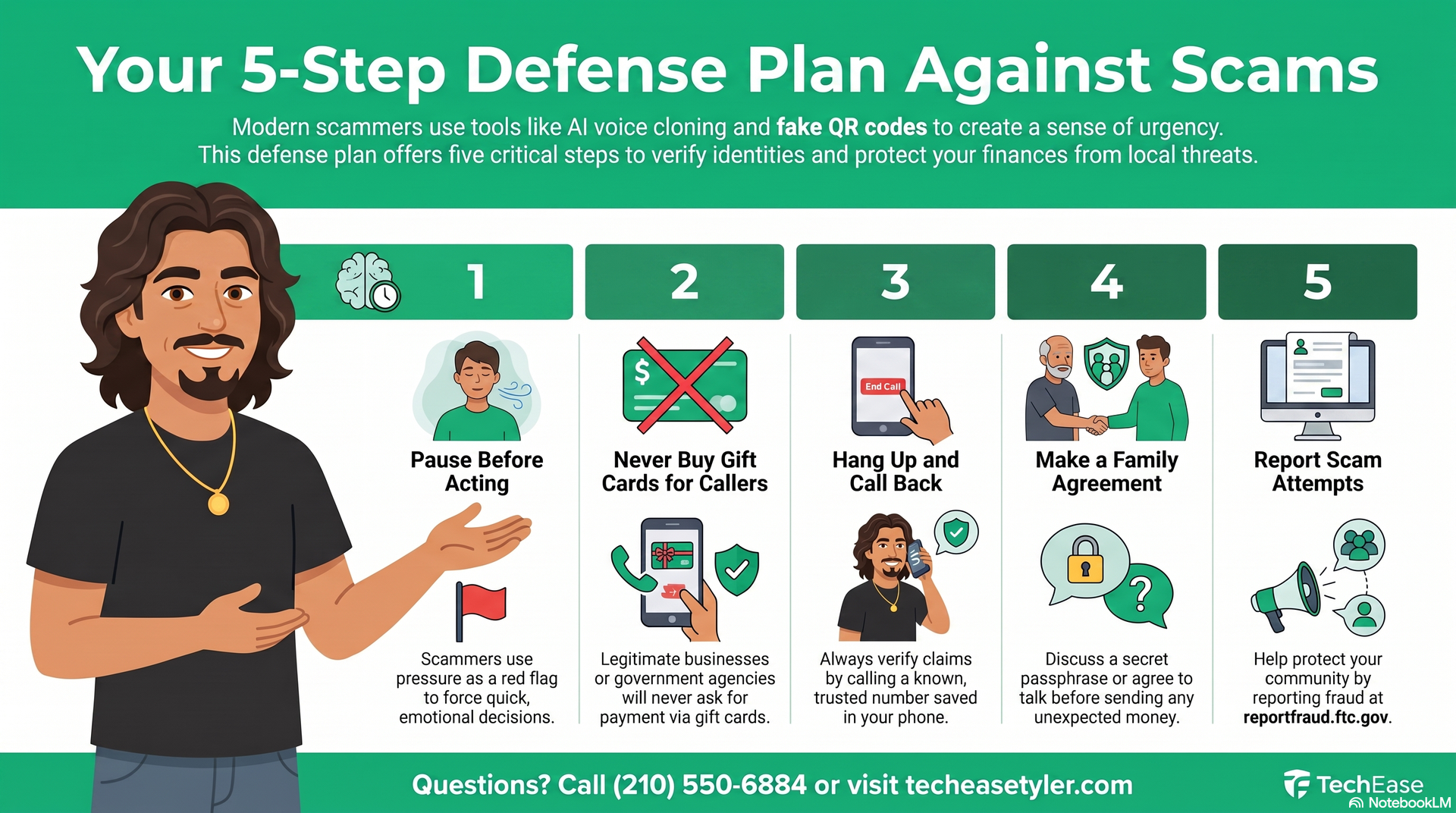
🔍 Your 5-Step Defense Plan
Knowing a scam exists is good. Having a plan ready so you do not have to think under pressure is better. Here are five things you can do right now that will protect you from almost every scam you will ever face.
Scammers rush you on purpose. The moment you feel pressure to act right now, that is your sign to slow down and hang up.
No government agency, utility company, or legitimate business ever accepts payment in gift cards. That is always, always a scam.
Always verify by calling back on a number you already know, from your card, your bill, or the official website. Never use a number a caller gives you.
Agree with a family member that before sending any money to anyone unexpected, you both talk about it first. One conversation can save thousands of dollars.
Report scam attempts to the FTC at reportfraud.ftc.gov. You will not get in trouble, and your report helps protect other Tyler families from the same criminals.
📞 Who to Call If You Have Been Targeted
If you believe you have been contacted by a scammer, or if you sent money and realized it was a scam, call one of these organizations right away. Acting quickly can sometimes stop or recover a fraudulent transaction.
God Bless.
Robert
Owner, TechEase
"No jargon, no judgment, just patient help that makes sense."
📞 (210) 550-6884 | Transparent Flat-Rate Pricing | We Come to You